Recently, I have been reading Drink for Nutrition: Clarifying Doubts About Drinking Water, Minerals and Health by Professor Shu Weiqun from Army Medical University.
I seldom read books usually, as I always feel that long-form content is easy to cause pressure.
Therefore, I deliberately slowed down my pace this time and read carefully page by page. After a week, I have only finished a quarter of the book, but the feeling of flipping through a few pages and memorizing a few knowledge points every day is really good.
The chapter design of this book is very considerate—most chapters are only two or three pages long, with concise content and little pressure. When memorizing knowledge points, I can also remember them more firmly, and there is no burden of "being unable to read on".
What impressed me most after reading are two points that subverted my previous cognition, especially the content about "minerals in drinking water", which completely changed my understanding of "drinking water".
Professor Shu Weiqun mentions in the book that most minerals in drinking water are in the form of soluble ions, such as common elements like calcium and magnesium, which are particularly easy for the human body to absorb.
The book also cites research data: the absorption rate of calcium in water can reach 22.53%, which is almost the same as that of calcium in milk (23.15%); the gap in magnesium absorption is even more obvious— the absorption rate of magnesium in solid foods is generally no more than 40%, while that of magnesium in water can be as high as 70%.
I don’t think there is any kind of water in the world that can really "cure all diseases" as advertised. However, I also don’t quite agree with the view that "water is just water and has no nutritional value at all".
If there were three types of water in front of me for me to choose as long-term drinking water—pure water produced by RO reverse osmosis, municipal tap water, and mineral-like water filtered by ultrafiltration membranes—I would definitely choose ultrafiltration water first, followed by municipal tap water, and finally pure water.
Pure water is clean, but it contains no minerals or trace elements, so drinking it is not healthy.
Tap water filtered by ultrafiltration can retain the minerals and trace elements in the water, while removing impurities such as sediment, rust, colloids, bacteria, and viruses from the water. It is not only clean but also healthy.
Municipal tap water, after treatment in waterworks, meets the drinking water standards and also retains the trace elements and minerals in the water. However, after long-distance pipeline transportation, it contains impurities, bacteria, and residual chlorine. Boiling can kill the microorganisms in the water and remove the residual chlorine, but the impurities still remain in the water.
Although it may not be so clean, it is safe.
Second, in the process of humanity’s continuous conquest of nature, soil quality has gradually degraded, and the mineral content in human food has been on the decline—take calcium, for instance, which is the mineral most demanded by the human body.
Calcium in the human diet is not abundant.
For people with an Eastern dietary pattern, which is dominated by grains and low in dairy products, calcium deficiency is not only common but also severe.
The TDS (Total Dissolved Solids) value measures the content of soluble substances in water, among which calcium ions and magnesium ions account for the largest proportion.
Many people believe that a water purifier that can reduce the TDS value to a single digit is a good one.
However, RO (Reverse Osmosis) water purifiers mainly remove calcium and magnesium ions—substances essential to the human body.
Many claim that ultrafiltration cannot lower the TDS value, making its filtered water unfit for direct drinking, and that this is a drawback of ultrafiltration.
But wait, the TDS value of boiled tap water is also not low, right?
The reason tap water in our country is not suitable for direct drinking is that it contains bacteria and viruses, making it insufficiently clean.
Therefore, a certain amount of chlorine must be retained in the water all the way to the terminal faucet to inhibit the growth of bacteria and viruses.
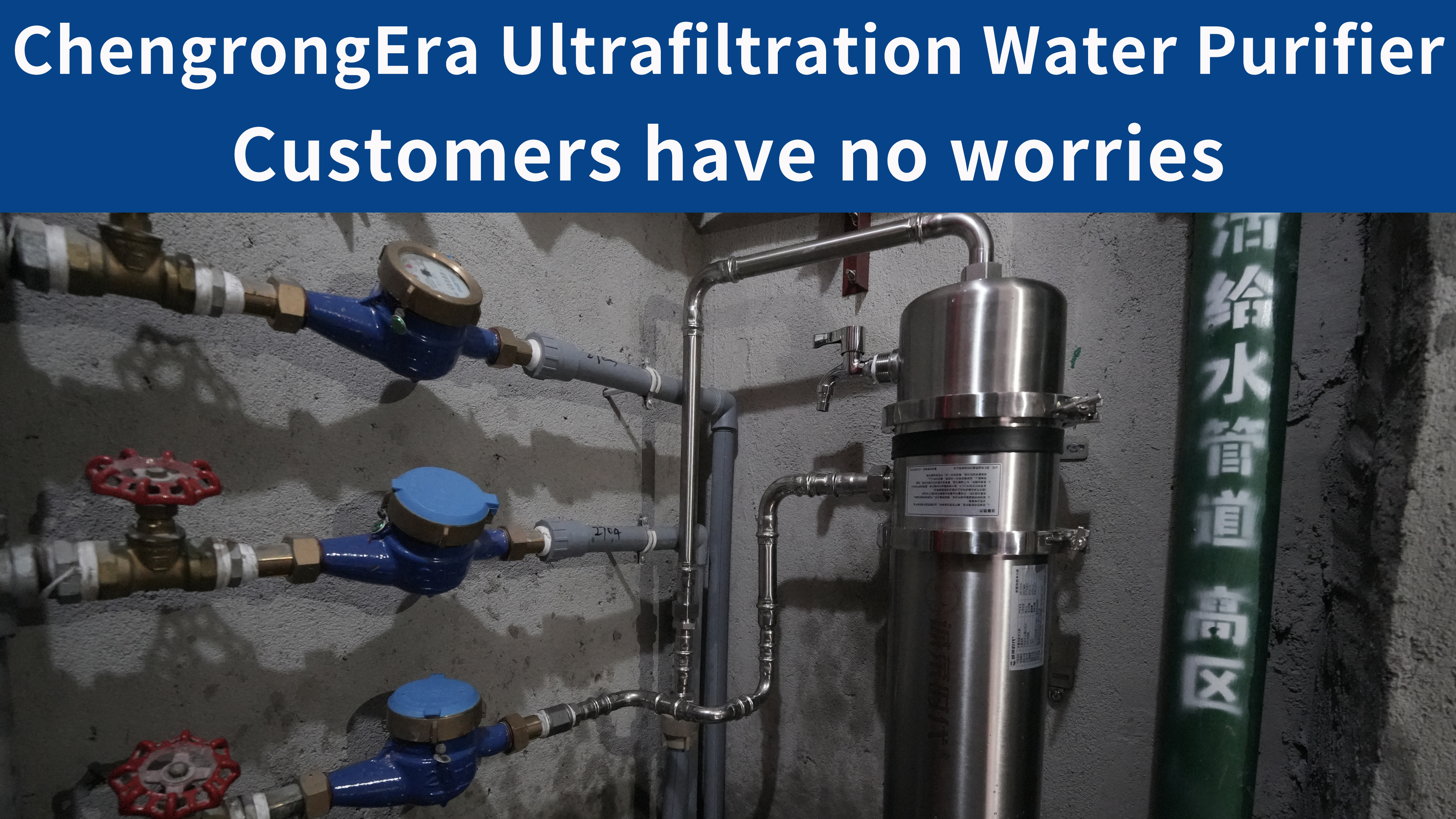
ChengrongEra Kitchen Water Purifier can meet the standards for direct drinking.
This is because we use genuine ultrafiltration technology with a filtration precision of 0.01 microns.
In contrast, many competitors cannot solve the problems of multi-stage filtration and low water flow, so they mostly use "fake ultrafiltration" with a precision of only 0.2~0.45 microns—a level that cannot completely filter out bacteria and viruses in water.
Only an ultrafiltration membrane with a precision of 0.01 microns can effectively filter out particulate impurities, bacteria, and viruses from water. Additionally, the ultrafiltration membrane used in our kitchen water purifier also has the function of removing residual chlorine from water. This is an exclusive technology of Chengrong, which other competitors cannot replicate.
Therefore, the purified water produced by our ultrafiltration system meets the standards for direct drinking—it is both clean and healthy.
That said, it is also true that not all ultrafiltration water purifiers can achieve such a purification effect. The industrial production of ultrafiltration membranes is highly challenging, and not all manufacturers can master it; in fact, 90% of them cannot do it well.
The reason RO membranes were commercialized earlier than ultrafiltration membranes lies in the greater difficulty of producing ultrafiltration membranes—not because ultrafiltration membranes cannot filter heavy metals.
In fact, water sources with excessive heavy metal content are not suitable for drinking water in the first place, as such water falls into the category of toxic substances.
Even though RO membranes can filter out heavy metals, if you know the water has excessive heavy metal levels, you may still hesitate to drink it. After all, you cannot be sure whether your RO membrane is damaged, and you will not test the TDS value of the water every day.
So, what RO membranes mainly remove are calcium and magnesium ions—minerals essential to the human body.
Now, there is a growing trend: many high-end RO reverse osmosis brands have begun to realize the shortcomings of RO-produced pure water (which lacks minerals) and are shifting toward adding minerals to the water. However, this mineralization process takes too little time, resulting in poor absorption by the human body.
The purified water produced by ChengrongEra Mineral-like Kitchen Water Purifier is both clean and healthy—a standard that is hard to find in other products in the industry.
Chengrong Ultrafiltration, customers never have to worry
No rust for ten years
No leaks for ten years
after-sales service also for ten years
ChengrongEra Water Purifier, never compromise on quality